
ASHRAE, the American Society of Heating, Refrigerating and Air-Conditioning Engineers, classifies refrigerants according to two important safety characteristics:
- Toxicity
- Flammability
Understanding these classifications is essential for engineers, technicians, installers and system owners because different refrigerants require different safety measures during installation, servicing, charging and operation.
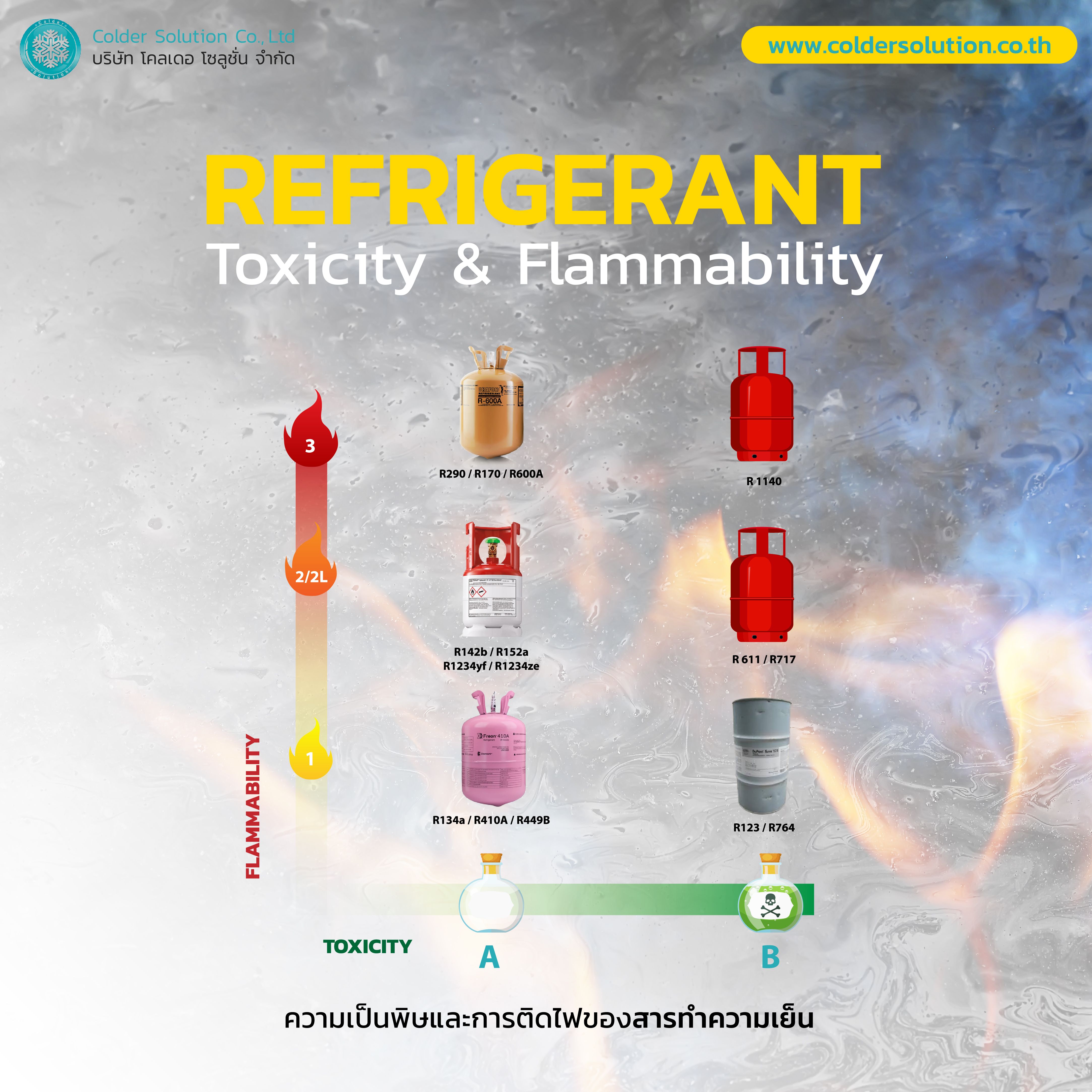
Refrigerant Toxicity Classification
ASHRAE divides refrigerants into two toxicity groups: Class A and Class B.
Class A: Lower Toxicity
Class A refers to refrigerants classified as having lower toxicity based on occupational exposure criteria.
Examples include:
- R-22
- R-134a
- R-410A
- R-32
- R-1234yf
Many commonly used refrigerants are classified in Group A.
However, the letter A should be understood as lower toxicity, rather than meaning that the refrigerant is completely non-toxic under every possible condition.
Any refrigerant can still present risks in poorly ventilated spaces because a large refrigerant release can displace oxygen.
Class B: Higher Toxicity
Class B refers to refrigerants with higher toxicity characteristics under the applicable classification criteria.
Examples include:
- R-717, Ammonia
- R-514A
Ammonia has been widely used in industrial refrigeration for many years because of its excellent thermodynamic performance.
However, because of its toxicity, ammonia systems require appropriate safety measures such as:
- Leak detection
- Ventilation
- Emergency procedures
- Machinery room requirements
- Personal protective equipment
- Technician training
Refrigerant Flammability Classification
Flammability describes the ability of a refrigerant to ignite and support flame propagation under specified test conditions.
ASHRAE classifies refrigerant flammability into four main categories:
- Class 1
- Class 2L
- Class 2
- Class 3
Class 1: No Flame Propagation
Class 1 refrigerants do not exhibit flame propagation under the specified standard test conditions.
Common examples include:
- R-134a
- R-410A
- R-513A
When combined with Toxicity Class A, these refrigerants are classified as A1.
A1 refrigerants have historically been widely used in refrigeration and air-conditioning because they combine lower toxicity with no flame propagation under classification test conditions.
Class 2L: Lower Flammability with Low Burning Velocity
Class 2L is a lower-flammability subclass introduced to distinguish refrigerants that have relatively low flame propagation characteristics and a burning velocity not greater than approximately 10 cm/s under the relevant test conditions.
Examples include:
- R-32
- R-1234yf
- R-1234ze(E)
- R-454B
When combined with Toxicity Class A, these refrigerants are classified as A2L.
A2L refrigerants are becoming increasingly important as the HVAC-R industry transitions toward lower-GWP refrigerants.
Class 2: Flammable
Class 2 refrigerants have higher flammability than Class 2L refrigerants but lower flammability than Class 3 refrigerants.
Systems using Class 2 refrigerants require appropriate controls relating to:
- Refrigerant charge
- Ventilation
- Room size
- Leak detection
- Potential ignition sources
- Service procedures
Class 3: Higher Flammability
Class 3 represents refrigerants with higher flammability.
Hydrocarbon refrigerants are common examples, including:
- R-290, Propane
- R-600a, Isobutane
- R-1270, Propylene
These refrigerants are commonly classified as A3, meaning:
A = Lower Toxicity
3 = Higher Flammability
Hydrocarbon refrigerants offer several environmental advantages, including extremely low GWP and zero ODP, but their higher flammability requires careful system design and strict safety procedures.
How to Read Refrigerant Safety Classes
The ASHRAE safety class combines the toxicity group and flammability group.
| Safety Class | Toxicity | Flammability |
|---|---|---|
| A1 | Lower toxicity | No flame propagation |
| A2L | Lower toxicity | Lower flammability, low burning velocity |
| A2 | Lower toxicity | Flammable |
| A3 | Lower toxicity | Higher flammability |
| B1 | Higher toxicity | No flame propagation |
| B2L | Higher toxicity | Lower flammability, low burning velocity |
| B2 | Higher toxicity | Flammable |
| B3 | Higher toxicity | Higher flammability |
For example:
R-32 = A2L
Lower toxicity with lower flammability.
R-290 = A3
Lower toxicity with higher flammability.
R-717 = B2L
Higher toxicity with lower flammability characteristics.
From A1 to A2L and A3 Refrigerants
For many years, a large proportion of commonly used HFC and HCFC refrigerants were classified as A1.
Examples include:
- R-22
- R-134a
- R-410A
However, the transition toward lower-GWP refrigerants has increased the use of refrigerants classified as A2L and A3.
Many HFO refrigerants and HFO-based blends fall into the A2L category.
Examples include:
- R-1234yf
- R-1234ze(E)
- R-454B
Natural hydrocarbon refrigerants such as R-290 and R-600a are generally classified as A3.
Ammonia, R-717, is classified as B2L.
Why A2L and A3 Refrigerants Are Becoming More Important
The refrigeration, air-conditioning and heat-pump industries are moving toward refrigerants with lower Global Warming Potential.
This transition is increasing interest in refrigerants such as:
- R-32
- R-1234yf
- R-1234ze(E)
- R-454B
- R-290
- R-600a
- R-1270
Many of these refrigerants provide significantly lower GWP compared with older HFC refrigerants.
However, lower GWP can come with different safety characteristics.
This means that the transition toward environmentally preferable refrigerants must also include improvements in:
- Equipment design
- Installation practices
- Refrigerant charge management
- Ventilation
- Leak detection
- Technician training
- Service procedures
Understanding the Lower Flammability Limit
For flammable refrigerants, one important parameter is the Lower Flammability Limit, or LFL.
The LFL represents the minimum concentration of refrigerant in air at which flame propagation can occur under specified test conditions.
If the refrigerant concentration remains below this limit, a flammable refrigerant and air mixture normally cannot sustain flame propagation under those conditions.
Different refrigerants have different LFL values.
For example, an A2L refrigerant such as R-32 requires a substantially higher concentration in air to reach its flammable range compared with an A3 hydrocarbon such as propane.
This difference is one reason why the permitted refrigerant charge, room volume, ventilation and mitigation requirements differ between A2L and A3 refrigerants.
Safety standards such as ISO 5149 and EN 378 provide requirements relating to refrigerant charge, occupied spaces, system design and risk mitigation.
A2L and A3: The Better You Understand Them, the Safer You Can Use Them
Next-generation refrigerants and natural refrigerants are becoming increasingly important because many offer extremely low GWP.
However, using A2L and A3 refrigerants safely requires proper understanding of their characteristics.
Installers, technicians and system operators should receive appropriate training and follow applicable safety standards.
Important considerations include:
- Refrigerant charge limits
- Room size
- Ventilation
- Leak detection
- Ignition-source control
- Electrical equipment
- Recovery equipment
- Service tools
- Refrigerant cylinders
- Charging procedures
A2L refrigerants generally require a higher concentration in air before reaching their flammable range compared with A3 refrigerants.
For example, the flammable concentration range of R-32 begins at a significantly higher refrigerant concentration than that of propane.
This does not mean A2L refrigerants can be handled without precautions.
It means that A2L and A3 refrigerants have different risk characteristics and therefore require different safety strategies.
Working Safely with Flammable Refrigerants
1. Do Not Retrofit an Incompatible System
Do not charge a flammable refrigerant into an HFC system or refrigeration circuit that was not specifically designed, approved or converted for that refrigerant.
Changing refrigerant safety classification can affect:
- Electrical equipment
- Compressor approval
- Refrigerant charge limits
- Leak detection
- Ventilation
- Pressure controls
- Service requirements
Always follow the equipment manufacturer's instructions.
2. Keep Refrigerant Charge as Low as Practical
System design should aim to minimize refrigerant charge while still providing the required cooling capacity and system performance.
Heat exchangers, piping and system design can all influence total refrigerant charge.
Lower charge can reduce the quantity of refrigerant that could be released if a leak occurs.
3. Provide Appropriate Ventilation
When servicing equipment containing flammable refrigerants, the work area should have suitable ventilation.
The objective is to prevent refrigerant from accumulating to a concentration that could enter the flammable range.
Requirements should follow the applicable safety standard, equipment manufacturer instructions and local regulations rather than relying on one fixed distance for every installation.
4. Control Potential Ignition Sources
Before servicing an A2L or A3 system, evaluate potential ignition sources in the work area.
These may include:
- Open flames
- Sparks
- Hot surfaces
- Electrical switching devices
- Non-approved electrical equipment
- Welding or brazing activities
Appropriate procedures must be followed before opening or servicing the refrigerant circuit.
5. Use Appropriate Leak Detection
Leak detectors should be suitable for the refrigerant being serviced.
Detection equipment should be:
- Compatible with the refrigerant
- Properly maintained
- Regularly checked
- Used according to manufacturer instructions
Leak detection is particularly important when working with flammable refrigerants in enclosed spaces.
6. Use Suitable Tools and Service Equipment
Technicians working with flammable refrigerants should use equipment designed or approved for the relevant refrigerant class.
This can include:
- Recovery machines
- Vacuum pumps
- Leak detectors
- Charging equipment
- Electrical tools
- Ventilation equipment
Proper technician training is equally important.
Safety Is Part of Refrigerant Selection
Every refrigerant has different characteristics.
Before selecting or using a refrigerant, system designers, installers and operators should consider:
- Cooling performance
- Energy efficiency
- GWP
- ODP
- Toxicity
- Flammability
- Operating pressure
- Refrigerant charge
- System compatibility
- Price
- Regulations
- Safety requirements
Choosing a lower-GWP refrigerant is an important part of the industry's environmental transition, but it must go together with proper equipment design and safe working practices.
Related Article
Learn More About Hydrocarbon Refrigerants (HCs)
Colder Solution
Colder Solution provides consultation on refrigerants, refrigeration equipment and refrigerant selection for a wide range of HVAC-R applications.
If you need help selecting the appropriate refrigerant for your system, contact us:
Line ID: @Colder
Email: kantawan.coldersolution@gmail.com