
The global refrigeration and air-conditioning industry is entering a major transition as regulations increasingly target the production, consumption, and use of high-GWP HFC refrigerants.
R-410A, one of the most widely used refrigerants in modern air-conditioning systems, is also being affected by this transition.
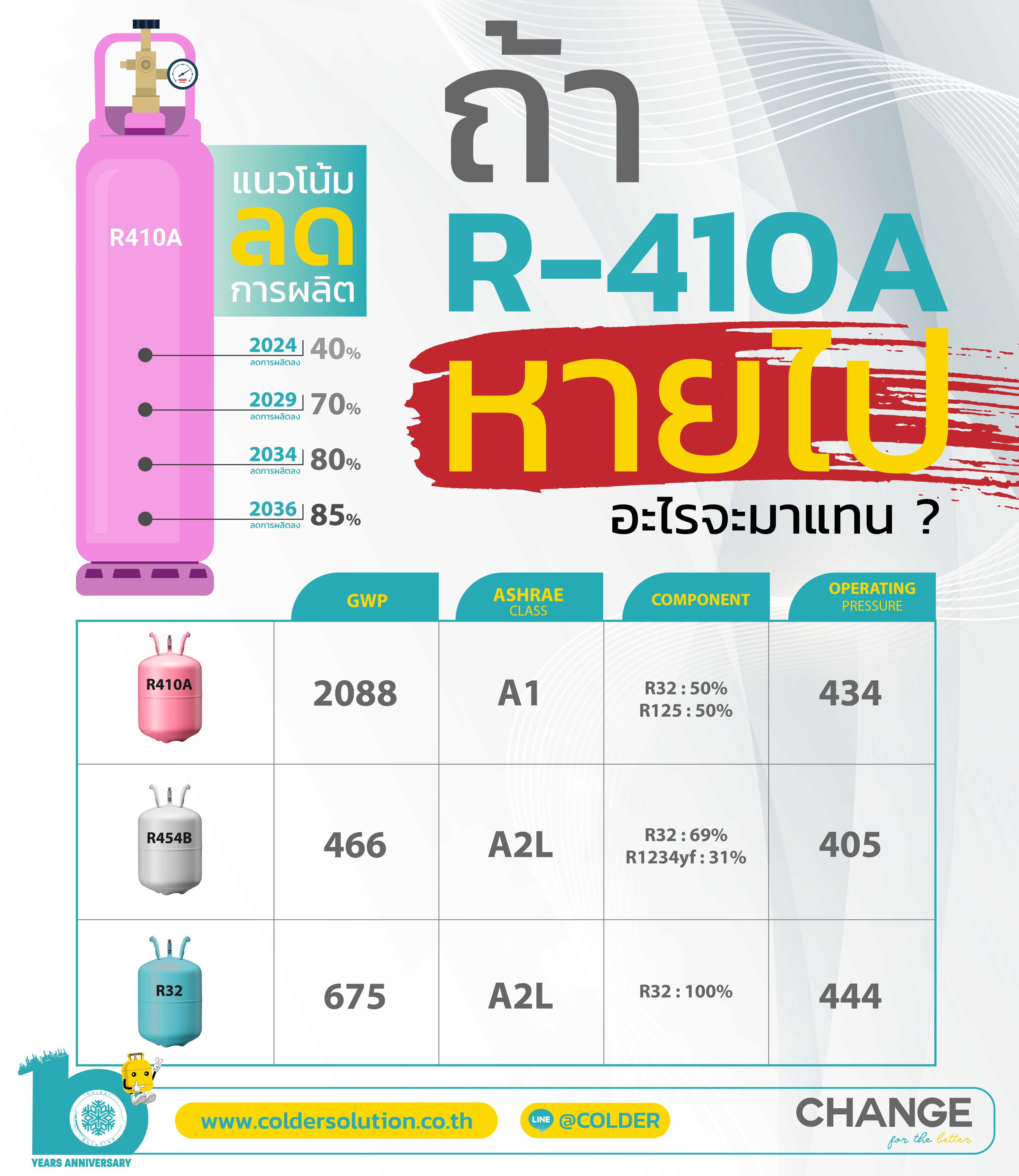
For example, under the U.S. AIM Act, HFC production and consumption allowances were reduced to 60% of baseline levels for 2024–2028, with the next step-down reducing allowances to 30% of baseline levels beginning in 2029.
This does not mean that R-410A will suddenly disappear from existing systems.
However, as regulations tighten and new equipment increasingly moves toward lower-GWP refrigerants, the HVAC industry is already preparing for a future in which R-410A plays a much smaller role.
Today, Colder Solution compares two of the most important lower-GWP alternatives being considered for the next generation of air-conditioning systems:
R-32 and R-454B.
Getting to Know R-32 and R-454B
R-32
R-32 has been widely adopted in newer air-conditioning systems for many years.
R-32 is a single-component HFC refrigerant and is also one of the components used in R-410A.
Compared with R-410A, R-32 has a significantly lower Global Warming Potential (GWP) while providing favorable thermodynamic characteristics and high volumetric refrigeration capacity.
Its GWP is approximately 675, depending on the assessment methodology used, compared with approximately 2,088 for R-410A under IPCC AR4 values.
This has made R-32 an important lower-GWP option for applications such as:
- Residential air conditioners
- Mini-split systems
- Multi-split systems
- Heat pumps
- Selected light-commercial HVAC equipment
R-32 is classified as an A2L refrigerant, meaning it has lower toxicity and lower flammability.
R-454B
R-454B, commercially available from Chemours as Opteon™ XL41, is an HFC/HFO refrigerant blend.
It combines:
- R-32
- R-1234yf
R-454B was specifically developed as a lower-GWP alternative to R-410A for new air-conditioning and heat-pump equipment.
Its GWP is approximately 466–467, depending on the IPCC assessment basis, making it substantially lower than both R-410A and R-32.
Like R-32, R-454B is classified as A2L.
Major HVAC manufacturers have increasingly designed new equipment platforms around refrigerants such as R-454B as the industry transitions away from higher-GWP R-410A systems.
R-32 vs R-454B: What Is the Difference?
1. Global Warming Potential — GWP
One of the clearest differences between the two refrigerants is their climate impact.
| Refrigerant | Approx. GWP | Safety Class |
|---|---|---|
| R-410A | 2,088 | A1 |
| R-32 | 675 | A2L |
| R-454B | 466–467 | A2L |
GWP values may vary depending on the IPCC assessment methodology used.
Both R-32 and R-454B offer a significant reduction in direct GWP compared with R-410A.
However, R-454B has the lower GWP of the two, making it particularly attractive for equipment manufacturers seeking to meet increasingly stringent refrigerant regulations.
2. Applications
Where Is R-32 Commonly Used?
R-32 has become particularly popular in residential and smaller air-conditioning systems.
Its thermodynamic characteristics make it suitable for compact, high-efficiency equipment, and it has already achieved widespread global adoption.
Typical applications include:
- Residential split systems
- Mini-splits
- Multi-splits
- Heat pumps
- Small and medium HVAC systems
Where Is R-454B Being Used?
R-454B is increasingly positioned as an R-410A alternative for new equipment, particularly in:
- Residential air conditioning
- Light-commercial HVAC
- Heat pumps
- Packaged systems
- Larger air-conditioning equipment designed specifically for A2L refrigerants
R-454B was engineered to provide performance characteristics relatively close to R-410A while substantially reducing GWP.
3. Compressor Discharge Temperature
One technical consideration when comparing R-32 and R-454B is compressor discharge temperature.
R-32 can operate with relatively high discharge temperatures under certain conditions.
This must be considered when designing compressors and refrigeration circuits, particularly under high compression ratios or demanding operating conditions.
R-454B combines R-32 with R-1234yf, allowing equipment designers to achieve a different balance between:
- Capacity
- Efficiency
- Operating pressure
- Discharge temperature
- GWP
This is one reason R-454B has attracted significant attention from manufacturers developing the next generation of R-410A-type equipment.
4. Safety
Both R-32 and R-454B are classified as A2L refrigerants.
A2L means:
- A = Lower toxicity
- 2L = Lower flammability with a relatively low burning velocity
They therefore require different safety considerations compared with R-410A, which is classified as A1.
Depending on the equipment and application, A2L systems may require consideration of:
- Refrigerant charge limits
- Room size
- Ventilation
- Leak detection
- Ignition-source control
- Electrical components
- Installation requirements
- Service procedures
- Technician training
The transition from R-410A to A2L refrigerants is therefore not simply a refrigerant change — it also affects equipment design and service practices.
5. Can R-454B Be Retrofitted Directly into an R-410A System?
No. R-454B should not be treated as a direct drop-in retrofit for an existing R-410A system.
Although R-454B was developed as an R-410A replacement in terms of its role in the market, manufacturers such as Chemours specify it primarily for new equipment designed for R-454B.
There are several reasons for this.
R-410A is classified as A1, while R-454B is A2L.
Therefore, an existing R-410A system may not have been designed for:
- A2L refrigerant charge requirements
- Leak mitigation
- Safety controls
- Electrical requirements
- Refrigerant detection
- A2L servicing procedures
The compressor, expansion device, controls, heat exchangers, and other system components must also be approved for the new refrigerant.
The same principle applies to R-32.
An existing R-410A system should not simply be emptied and refilled with R-32 or R-454B.
These refrigerants are primarily intended for equipment specifically designed and approved for their use.
R-32 vs R-454B at a Glance
| Comparison | R-32 | R-454B |
|---|---|---|
| Refrigerant Type | HFC | HFC/HFO Blend |
| Main Components | R-32 | R-32 + R-1234yf |
| GWP | ~675 | ~466–467 |
| Safety Class | A2L | A2L |
| Flammability | Lower Flammability | Lower Flammability |
| Typical Market | Residential / Split AC / Heat Pumps | New AC / Heat Pump Equipment |
| R-410A Alternative | Yes, in equipment designed for R-32 | Yes, in equipment designed for R-454B |
| Direct Drop-in for Existing R-410A | No | No |
| Key Advantage | Single-component refrigerant, established market | Lower GWP and performance designed close to R-410A |
Which Refrigerant Is More Sustainable?
If sustainability is evaluated only by Direct GWP, R-454B has the advantage over R-32.
However, the environmental performance of an air-conditioning system should not be evaluated by GWP alone.
A more complete assessment should also consider:
- Energy efficiency
- Annual electricity consumption
- Refrigerant charge
- Leakage rate
- Equipment lifetime
- Service requirements
- Refrigerant recovery
- End-of-life management
A lower-GWP refrigerant used in an inefficient system does not automatically produce the lowest total climate impact.
Therefore, the best solution is the refrigerant that provides the right balance between:
GWP + Energy Efficiency + Safety + Equipment Design + Reliability
So, What Will Replace R-410A?
There may not be a single refrigerant that replaces R-410A in every application.
Instead, the market is moving toward multiple lower-GWP solutions designed for different equipment categories.
Two of the most important options are:
R-32
A well-established lower-GWP option that has already gained widespread adoption, particularly in residential and smaller air-conditioning systems.
R-454B
A lower-GWP HFC/HFO blend specifically developed as an R-410A alternative for new air-conditioning and heat-pump equipment, with characteristics designed to provide a relatively close performance match to R-410A.
As environmental regulations continue to tighten, both refrigerants are likely to play important roles in the transition away from high-GWP R-410A.
The real change, however, is bigger than simply replacing one refrigerant with another.
The HVAC industry is moving toward a new generation of equipment designed around lower GWP, higher efficiency, updated safety requirements, and long-term sustainability.
Preparing for the Future of Refrigerants
The transition away from R-410A will continue to influence:
- Equipment manufacturers
- Contractors
- HVAC technicians
- Building owners
- Facility managers
- Refrigerant distributors
- System designers
Understanding the differences between refrigerants today can help businesses prepare for the equipment, regulations, and service requirements of tomorrow.
Because the question is no longer simply:
“Will R-410A be replaced?”
The more important question is:
“Which refrigerant is right for the next generation of your system?”
Colder Solution
Colder Solution is ready to provide advice and refrigerant solutions to help businesses confidently “change” and move toward a more sustainable future.
We import and distribute quality refrigerants from leading brands including:
- Orafon
- Honeywell
- Klea
- DuPont
- Daikin
- and others
We also supply:
- Compressors
- Danfoss refrigeration components
- Refrigeration spare parts
- High-quality refrigeration lubricants
- Other HVAC-R equipment and components
Contact Us
Line ID: @Colder
Email: kantawan.coldersolution@gmail.com