
The Most Commonly Used Refrigerants and Future Trends
Since 1928, when Thomas Midgley Jr. and his research team began developing non-flammable, lower-toxicity fluorinated refrigerants such as Freon R-12, hundreds of refrigerants have been developed to meet changing requirements in technology, applications and environmental performance.
The refrigeration industry has continued to evolve alongside changing global environmental priorities, with lower-GWP refrigerants becoming increasingly important in finding a balance between cooling performance and environmental responsibility.
Which Refrigerants Have Been Widely Used?
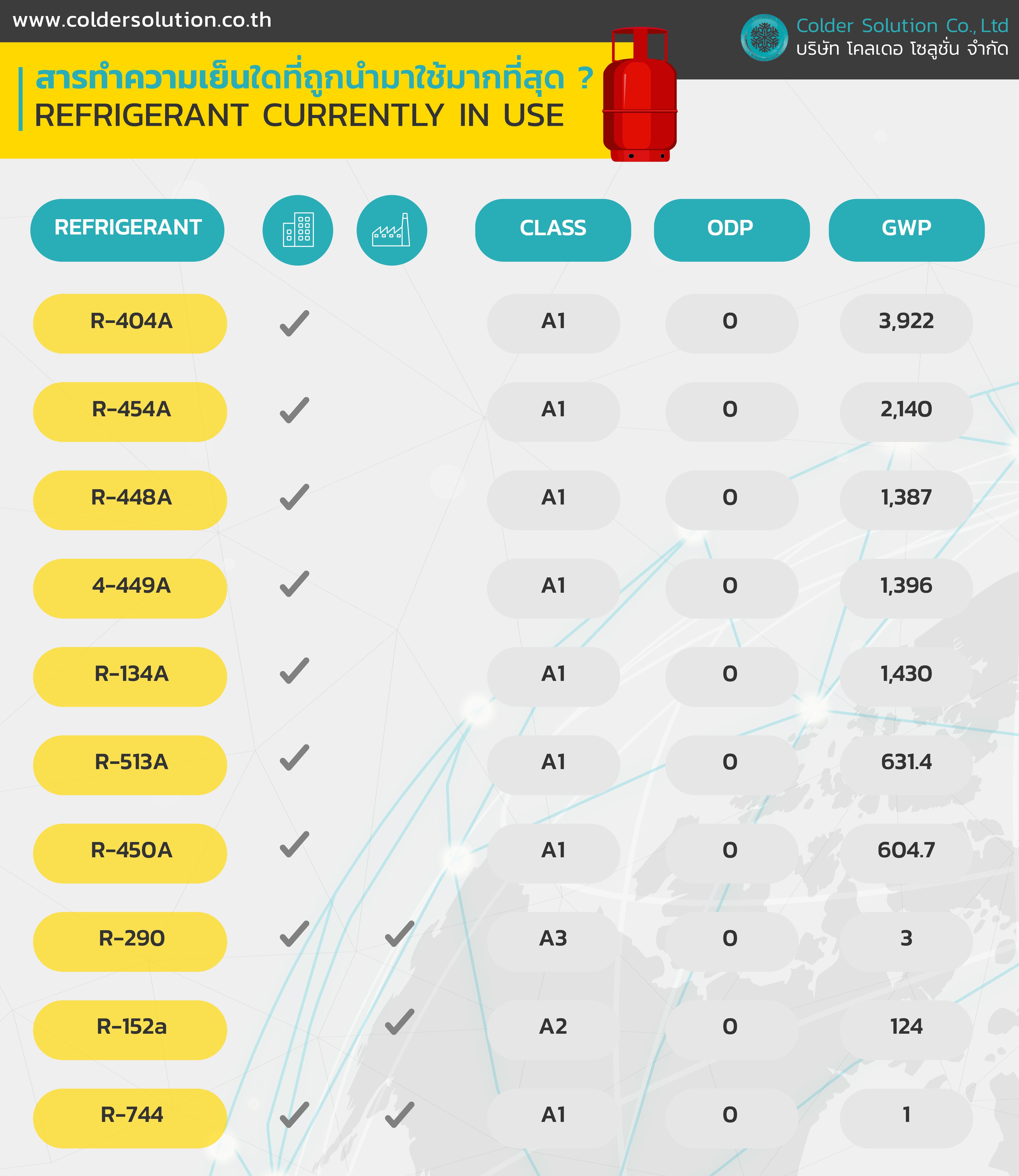
Based on global usage information referenced in October 2022, several refrigerants continued to be widely used in commercial and industrial refrigeration applications.
Over the past several decades, R-404A became one of the most widely used refrigerants for commercial and industrial refrigeration.
It was introduced as an alternative to refrigerants such as R-22 and R-502 and has been widely applied in:
- Commercial refrigeration
- Industrial refrigeration
- Freezers
- Cold rooms
- Refrigerated transport
- Cold-chain applications
Its refrigeration characteristics allow R-404A to operate across a wide range of low and medium-temperature applications.
Why Is R-404A Being Replaced?
Although R-404A has been widely used, its high Global Warming Potential (GWP) has become a major environmental concern.
R-404A has a GWP of approximately 3,922, which has resulted in increasing pressure to reduce its use and transition toward refrigerants with lower climate impact.
Alternatives include refrigerants such as:
These refrigerants offer lower GWP values than R-404A and have been developed for selected commercial, industrial and transport refrigeration applications.
The appropriate replacement still depends on system design, operating temperature, compressor compatibility and manufacturer recommendations.
Future Refrigerant Trends
HFC refrigerants, or Hydrofluorocarbons, became widely used in refrigeration from the 1990s onward as replacements for CFC and HCFC refrigerants that contributed to ozone depletion.
Unlike CFCs and HCFCs, HFC refrigerants contain no chlorine and therefore have zero Ozone Depletion Potential.
However, many traditional HFC refrigerants still have high GWP values.
As global demand for cooling continues to increase, particularly in developing economies and warmer climates, reducing emissions from high-GWP refrigerants has become an increasingly important environmental objective.
The refrigeration and air-conditioning industry is therefore gradually transitioning toward alternatives such as:
- Lower-GWP HFC blends
- HFO refrigerants
- HFO/HFC blends
- Natural refrigerants
The future of refrigerant selection will increasingly require a balance between:
Performance + Quality + Safety + Cost + Environmental Impact
Colder Solution
Colder Solution is committed to selecting refrigerants that provide an appropriate balance between performance, quality, safety, cost and environmental responsibility.
We can also source refrigerants according to customer requirements, providing more options to support changing regulations and evolving refrigeration technologies.
Contact Us
Line ID: @Colder
Email: kantawan.coldersolution@gmail.com