
Global Refrigerant Trends : The Executive Guide to the HFC Phase-Down and Low-GWP Alternatives
Refrigeration is the invisible backbone of the global industrial and commercial economy. For decades, the industry relied heavily on popular HFCs such as R-410A, R-404A, and R-407C for medium-scale operations, while R-134a and R-123 dominated massive centrifugal chiller applications.
However, the thermodynamics of the past are colliding with the environmental imperatives of the future. The Kigali Amendment and subsequent global protocols have initiated a massive phase-down of high-GWP (Global Warming Potential) refrigerants. With production quotas shrinking, procurement officers are witnessing unprecedented price volatility for legacy HFCs.
Expert Insight: Navigating 50 Years of HVACR Evolution
Observing half a century of refrigeration history, the current paradigm shift is the most disruptive we have ever seen. We are no longer just engineering for Delta-T and energy efficiency; we are engineering for regulatory survival and planetary impact. The transition from HFCs to HFOs and natural refrigerants is not merely a chemical swap it is a complete reimagining of system architecture, demanding rigorous adherence to ASHRAE safety classifications and proactive lifecycle management.
Because regional regulatory bodies govern this transition differently, multinational corporations and local enterprises alike must understand the fragmented landscape of the global HVACR market.
Analyzing the Global Regulatory Landscape Different markets dictate different operational rules. Here is how the world's leading economies are enforcing the shift toward low-GWP solutions.
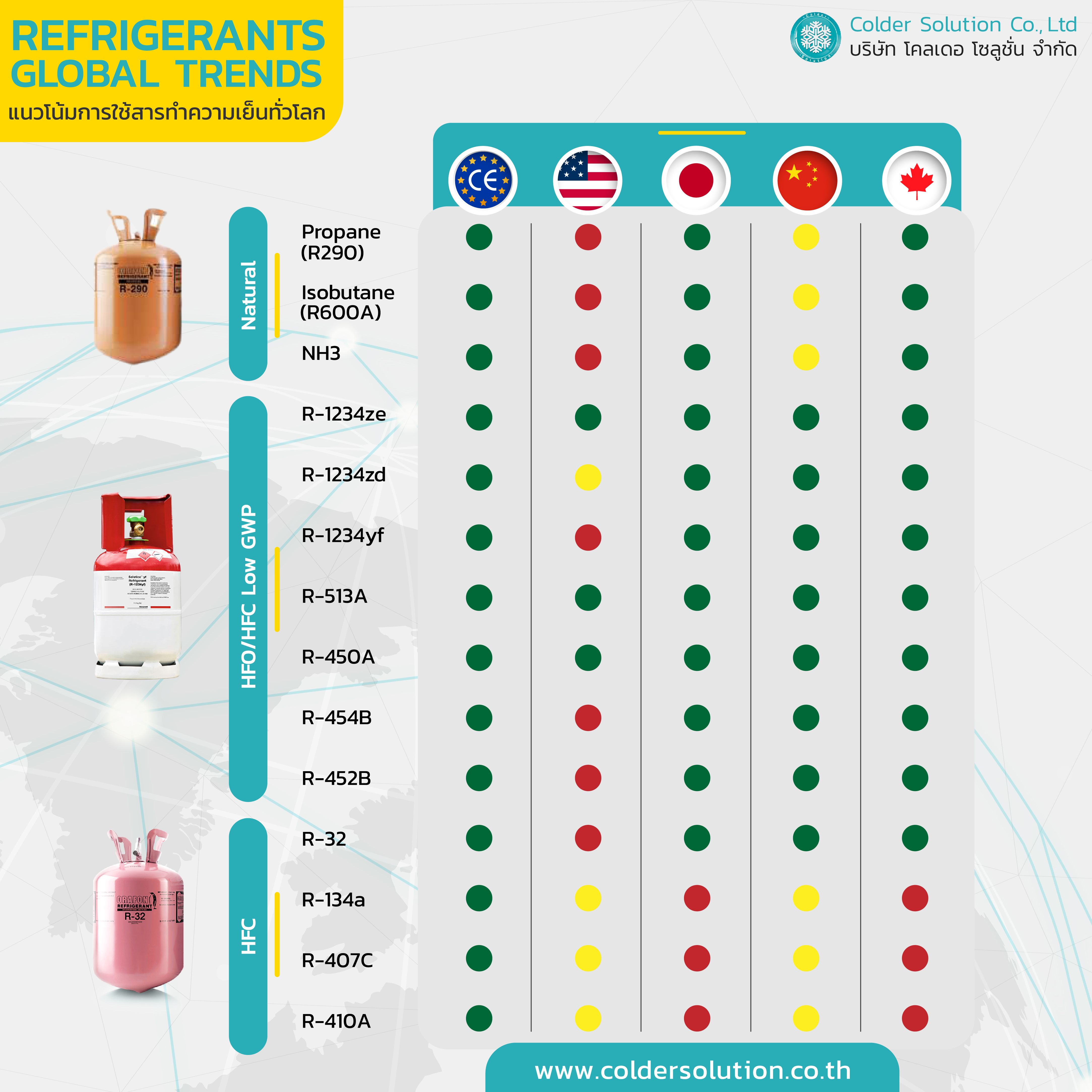
The European Union: Pioneering the F-Gas Regulation Under the stringent F-Gas framework, chillers fall under "stationary refrigeration equipment." The EU decisively banned refrigerants with a GWP exceeding 2500 back in 2020. While legacy fluids like R-410A, R-407C, and R-134a remain in circulation, they are subject to rigorous mandatory leak inspections. The frequency of these inspections correlates directly to the refrigerant's GWP and charge size (e.g., mandatory checks for R-410A > 2.4 kg, R-407C > 2.8 kg, and R-134a > 3.5 kg).
Faced with diminishing supply and escalating costs, the European market is aggressively adopting ultra-low GWP alternatives:
Hydrocarbons (HCs):
R-290 (Propane), R-600a (Isobutane), and R-170 (Ethane) boast near-zero GWP and zero ODP (Ozone Depletion Potential). While exempt from F-Gas leak checks, their high flammability (ASHRAE Class A3) requires strict adherence to local ATEX-style safety directives, often restricting them to outdoor installations.
Ammonia (R-717):
A staple in industrial cooling with zero GWP. Classified as B2L (toxic and mildly flammable), it requires heavy-duty engineering and rigorous safety protocols.
HFOs (R-1234yf, R-1234ze, R-1233zd):
Offering exceptional environmental profiles, but ze and yf are classified as A2L (mildly flammable), necessitating updated equipment designs to mitigate ignition risks.
Low-GWP A2L Blends (R-32, R-452B, R-454B):
Engineered as R-410A replacements, these require leak checks at higher charge volumes (e.g., 7.4 kg for R-32/R-452B; 10.8 kg for R-454B) and demand comprehensive A2L safety handling.
A1 Non-Flammable Blends (R-450A, R-513A):
Excellent drop-ins or alternatives for medium-temperature R-134a applications.
The United States: The SNAP Directive
The US Environmental Protection Agency (EPA), through its SNAP (Significant New Alternatives Policy) program, evaluates refrigerants based on compressor types (reciprocating, scroll, screw, centrifugal) and specific end-uses. While R-410A, R-404A, R-407C, and R-134a are still widely utilized in "industrial process refrigeration," the regulatory noose is tightening. The US market is rapidly transitioning toward sustainable alternatives like R-513A, R-450A, R-1234ze, and Ammonia to meet stringent ESG criteria, trading high GWP for the engineering challenges of managing A2L and B2L fluids.
Japan: The Fluorocarbon Management Act
Japan’s Act on Rational Use & Proper Management of Fluorocarbons set a hard GWP limit of 750 for commercial air conditioning (enforced in 2018) and commercial refrigeration (enforced in 2020). Consequently, R-410A and R-407C are virtually obsolete for new systems. The Japanese market leans heavily into A2L innovations (R-32, R-454B), HFOs, and natural refrigerants, backed by rigorous toxicity and flammability guidelines.
China & Canada: Accelerating the Phase-Out
China: While R-22 (an HCFC) is still prevalent, aggressive modernization is replacing it directly with R-32 or advanced HFOs, particularly in high-capacity centrifugal and screw chillers.
Canada:
Aligning closely with Japanese and European philosophies, Canada's updated halocarbon regulations effectively ban refrigerants with a GWP > 700 in new commercial and industrial systems starting January 2025, sounding the death knell for R-410A and R-407C in the North American north.
The Engineering Challenge
There is No "Magic" Drop-In While R-410A and R-407C remain widespread, the writing is on the wall. The transition to R-32, R-454B, R-513A, or natural refrigerants is not plug-and-play.
Expert Insight: The System Architecture Bottleneck One of the most critical misconceptions in the C-suite is the assumption that new low-GWP refrigerants can simply be retrofitted into existing hardware. They cannot. Legacy cooling units were not designed for the thermodynamic profiles, operating pressures, or the A2L flammability characteristics of next-generation fluids. Attempting inappropriate drop-ins compromises ARI 700 purity standards, ruins volumetric efficiency, and creates severe safety hazards.
This transition requires capital expenditure, time, and most importantly technical literacy. Technicians and facility managers must be upskilled to handle A2L safety protocols, and lifecycle management (Recovery, Recycling, and Reclamation) must be integrated into standard operating procedures.
Frequently Asked Questions
1. Why are the prices of R-404A and R-410A increasing so rapidly? Due to the Kigali Amendment and regional regulations (like the EU F-Gas and US EPA SNAP), the production quotas for high-GWP HFCs are being aggressively phased down. This artificial scarcity, combined with ongoing demand for servicing legacy equipment, is driving up costs significantly.
2. Can we use A2L refrigerants like R-32 or R-454B as drop-in replacements for R-410A?
No. A2L refrigerants are classified as mildly flammable. Existing systems designed for non-flammable A1 refrigerants lack the necessary safety mitigation components, spark-proof electricals, and thermodynamic sizing to safely or efficiently operate with A2L fluids. New equipment or heavily engineered retrofits are required.
3. What is the current acceptable GWP limit for new commercial refrigeration equipment?
While it varies by region, a globally recognized benchmark is emerging. Japan and Canada have set limits at a GWP of 750 or 700 for new equipment, while the EU has even stricter tier systems depending on the application. Procuring equipment utilizing refrigerants with a GWP under 700 is highly recommended for long-term compliance.
4. How does refrigerant lifecycle management affect our corporate Net Zero targets?
Scope 1 emissions include direct fugitive emissions from refrigerant leaks. Because legacy HFCs have a GWP thousands of times greater than CO2, even a minor leak drastically inflates a company's carbon footprint. Transitioning to ultra-low GWP refrigerants and implementing rigorous recovery and reclaim protocols is essential for achieving Net Zero and ESG compliance.
Colder Solution : Your Partner in Industry 4.0 Refrigeration
If executed correctly, the HFC phase-down is an opportunity. Upgrading to optimized, low-GWP systems results in superior Energy Efficiency Ratios (EER), significantly reduced operational costs, and future-proofed facilities.
At Colder Solution, we provide uncompromising quality and technical authority. We supply premium refrigerants from global leaders including Orafon, Honeywell, Klea, Chemours (DuPont), and Daikin alongside elite compressors and Danfoss components. Whether you need guidance on navigating ESG compliance, selecting the optimal low-GWP refrigerant for your specific industrial application, or ensuring the highest purity standards, our engineering consultants are ready to assist.
Contact our Engineering & Procurement Team :
Line Official Account : @Colder
Email : kantawan.coldersolution@gmail.com