
The Net Zero Imperative : Mastering the Refrigerant Life Cycle in Commercial HVACR
The United Nations’ World Environment Day campaign, #OnlyOneEarth, serves as a stark reminder of our planetary boundaries. While the universe boasts billions of galaxies, this is the only biosphere we have.
For the global HVACR sector, this is no longer just a philosophical concept; it is a hard engineering directive. Major metropolises from London to Bangkok are aggressively enforcing Net Zero carbon emission targets by 2030, targeting core infrastructure such as transportation, waste management, and crucially, the energy consumption and thermal emissions of commercial buildings.
Because refrigeration is inextricably linked to virtually every industrial process and modern comfort standard, our industry is at the epicenter of the climate change battle. Legacy refrigerants have historically contributed significantly to ozone depletion and global warming. However, the narrative is changing.
Navigating 50 Years of HVACR Evolution
In my five decades of engineering and consulting in the refrigeration sector, I have witnessed the phase-out of CFCs and HCFCs. But the critical shift we are seeing today is profoundly different. The mandate driven by the Kigali Amendment and global phasedown policies to aggressively slash HFCs is forcing the industry to fundamentally redesign system architectures. Let me be unequivocal: selecting a low-GWP refrigerant is merely the entry fee. The true test of a company's ESG integrity lies in how it manages that chemical from cradle to grave.
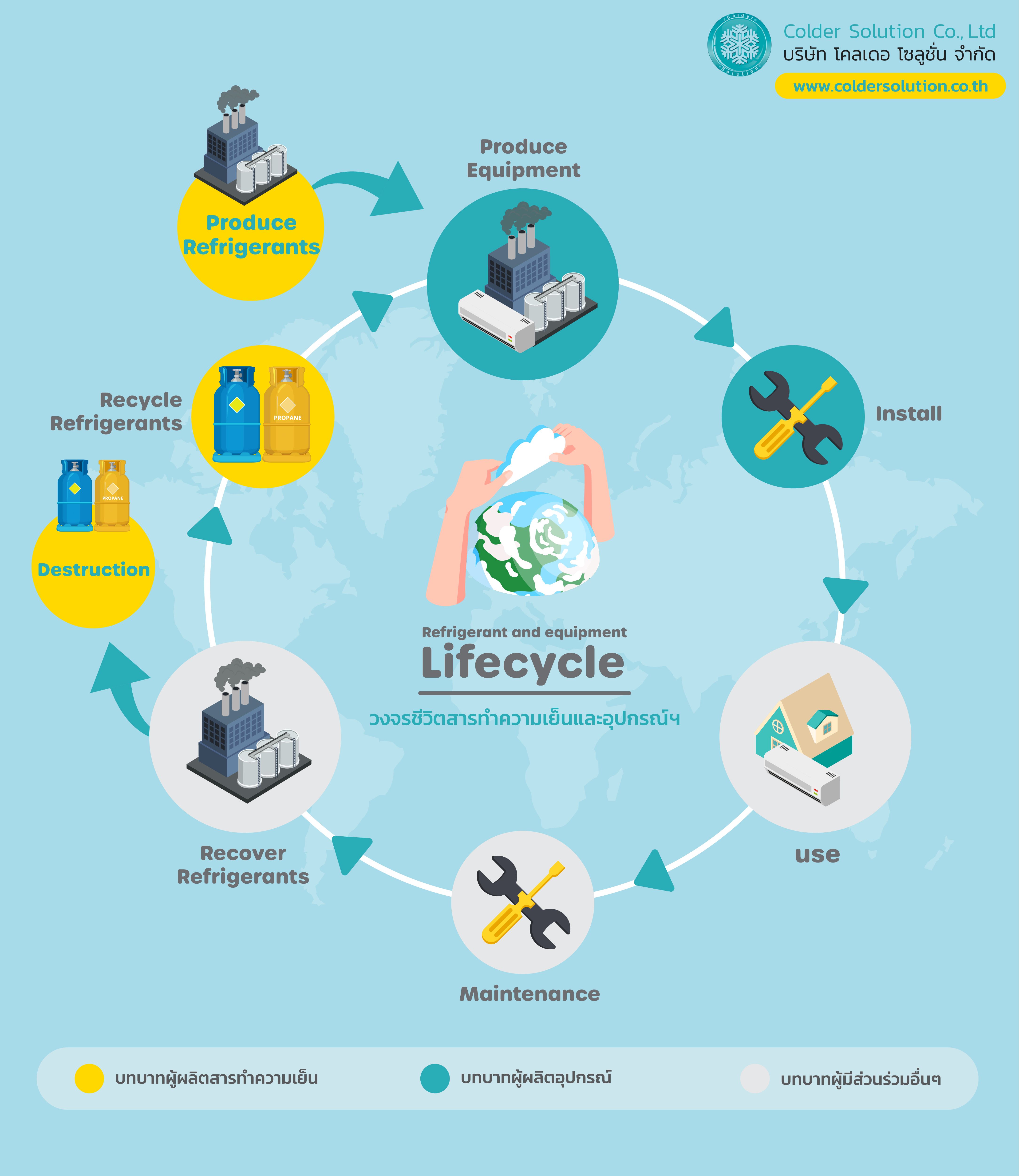
The Core Philosophy: Refrigerant Life Cycle Management
Adopting next-generation, low-GWP synthetic blends or natural refrigerants is just the first step. To achieve genuine sustainability, the industry must pivot toward a circular economy model.
This means executing flawless Refrigerant Life Cycle Management. We must prioritize leak prevention, systematic evacuation, and certified refrigerant recovery and reclamation. Reclaiming gases to AHRI/ARI 700 purity standards ensures that volatile chemicals are not vented into the atmosphere, simultaneously optimizing energy efficiency and drastically reducing a facility's Scope 1 emissions.
Achieving this requires a synchronized effort across three primary stakeholders :
1. The Chemical Manufacturers (Formulating the Future)
Global chemical producers are under immense pressure to synthesize refrigerants that meet diverse operational demands while adhering to strict environmental quotas. Their mandate includes:
• Regulatory Compliance : Engineering molecules with ultra-low GWP and zero Ozone Depletion Potential (ODP).
• Thermodynamic Viability : Balancing system safety (managing A2L/A3 flammability and toxicity) with cost-effectiveness for the end-user.
• Energy Optimization : Developing fluids that elevate the coefficient of performance (COP) in chillers, heat pumps, and AC units, thereby reducing indirect Scope 2 emissions.
Reclamation Infrastructure: Investing heavily in proprietary technologies to efficiently recycle and reclaim complex chemical blends.
2. The Original Equipment Manufacturers (OEMs)
HVACR equipment manufacturers must continuously innovate to harness the thermodynamic properties of new-age refrigerants. Their strategic role involves:
• System Synergy: Collaborating with chemical engineers to select the optimal refrigerant (whether fluorinated or natural/non-fluorinated) for specific applications.
• Charge Minimization: Designing highly efficient, low-volume microchannel heat exchangers that require significantly less refrigerant charge to achieve the necessary cooling capacity.
• Hermetic Integrity: Engineering robust, leak-resistant systems that minimize fugitive emissions throughout the equipment's operational lifespan.
3. Contractors, Engineers, and Facility Managers (The Frontline)
The most brilliant engineering is useless without flawless execution in the field. The end-users, maintenance technicians, and industry organizations bear the ultimate responsibility for sustainability:
• Proactive Leak Mitigation: Utilizing advanced leak detection technology and rigorous maintenance schedules.
• Recovery Protocol Adherence: Completely abandoning the archaic practice of venting. Technicians must be equipped with the technology and mandate to recover every ounce of gas.
• Technical Upskilling: Continuously training personnel on the safe handling of A2L (mildly flammable) and A3 (highly flammable) refrigerants, and establishing strict end-of-life protocols for recycling or safely destroying degraded fluids.
Frequently Asked Questions
1. What is "Refrigerant Life Cycle Management" and why is it critical for ESG reporting?
Refrigerant Life Cycle Management is the comprehensive process of tracking, maintaining, recovering, and reclaiming refrigerants from the moment they are installed until the equipment is decommissioned. Because fugitive emissions from leaks (Scope 1 emissions) severely impact a company's carbon footprint, strict life cycle management is essential for accurate ESG reporting and achieving Net Zero targets.
2. Does reclaiming refrigerant affect its cooling performance?
No, provided the refrigerant is reclaimed to the globally recognized ARI 700 standard. This rigorous distillation and filtration process removes moisture, acids, particulates, and non-condensable gases, restoring the refrigerant to its original, factory-grade thermodynamic purity.
3. How does the Kigali Amendment impact my current HVAC infrastructure?
The Kigali Amendment mandates a global, phased reduction in the production and consumption of high-GWP HFCs (like R-410A and R-404A). For facility managers, this means the cost of legacy refrigerants will surge as supply dwindles. Procuring new equipment must now account for compatibility with low-GWP alternatives, such as A2L blends or natural refrigerants, to ensure long-term operational viability.
4. Why can't OEMs just design equipment that never leaks?
While OEMs are utilizing advanced technologies like microchannel coils and brazed plate heat exchangers to drastically reduce leak rates, commercial HVACR systems operate under extreme pressures, thermal expansion, and constant vibration. Over a 15-to-20-year lifespan, minor micro-leaks can occur, making regular maintenance and frontline leak detection absolutely vital.
Colder Solution: Your Partner in Sustainable HVACR
Commercial refrigeration and air conditioning systems have operational lifespans spanning decades. Committing to a system architecture today means living with its environmental and financial footprint for the next twenty years. The ultimate challenge is striking the perfect equilibrium between CAPEX, operational safety, thermodynamic efficiency, and corporate environmental responsibility.
Colder Solution is perfectly positioned to deliver that equilibrium. We provide uncompromised, strategic solutions tailored to your specific industrial requirements.
As a premier importer and distributor, we supply the highest-grade refrigerants from global titans including Orafon, Honeywell, Klea, Chemours (DuPont), and Daikin. We also provide elite mechanical components, including industry-leading compressors, Danfoss spare parts, and premium-grade refrigeration lubricants.
If you are ready to future-proof your facility, optimize your cooling efficiency, and seamlessly navigate the HFC phase-down, consult with our engineering experts today.
Line Official Account : @Colder
Email : kantawan.coldersolution@gmail.com